
Austin ADU Rules: What to Check Before You Build
Austin ADU rules do not give every property one answer. The applicable path depends on the address, zoning, lot status, existing and proposed dwelling count, and site constraints.
Utilities, private restrictions, and current technical codes can add separate requirements. Start by identifying the City review path, then verify the size and site rules that apply to that property.
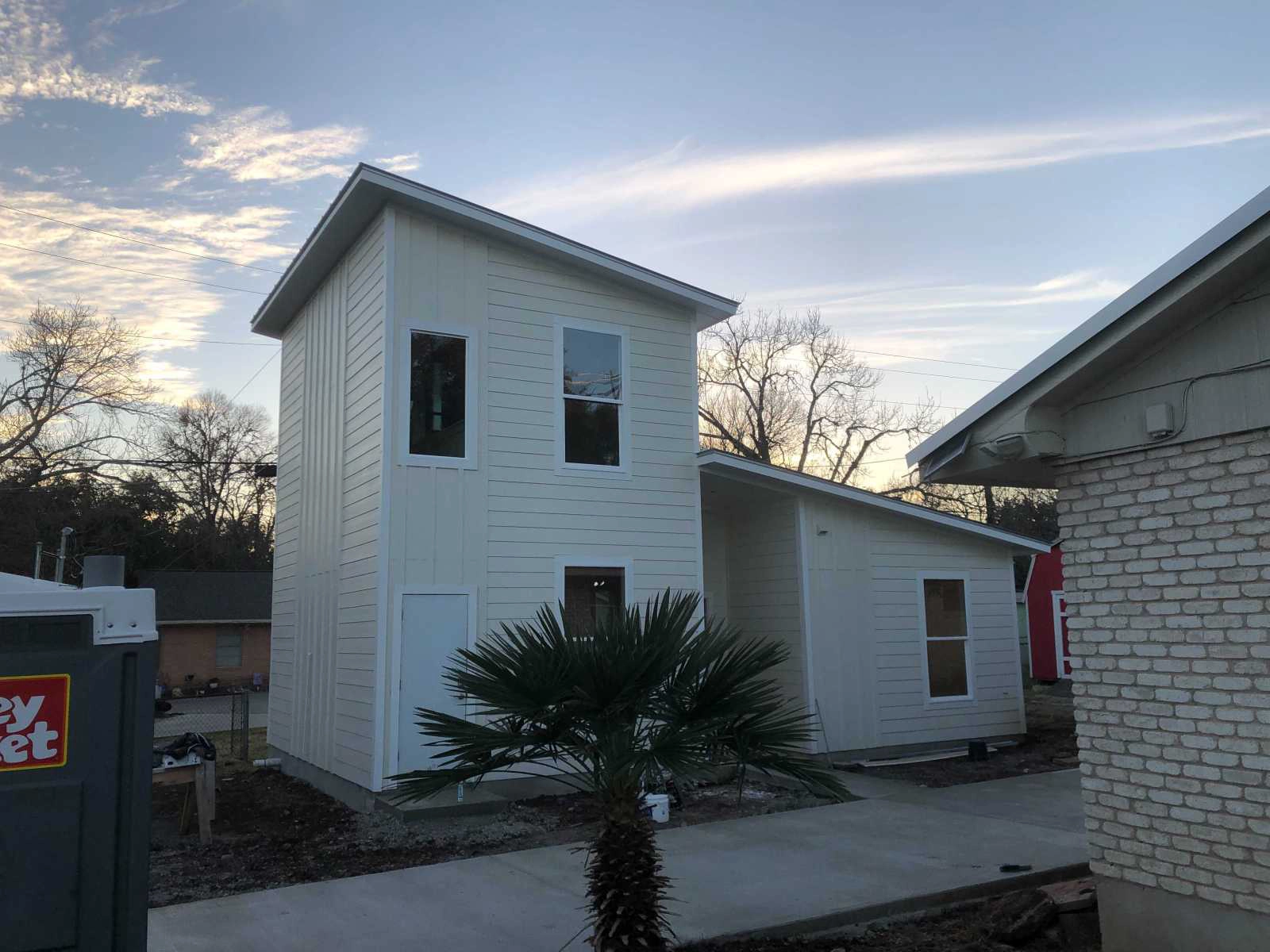
The City path comes before the floor plan.
“ADU” is useful homeowner language. The permit review still needs the correct dwelling count, land use, site standards, address, technical codes, and utility scope.
HOME does not mean every lot gets three units.
HOME Phase 1 allows up to three units in certain SF-1, SF-2, and SF-3 projects, but the site and applicable standards still control.
There is no safe universal ADU size.
Size is shaped by the review path, zoning, location, floor-area rules, coverage, height, setbacks, trees, drainage, and technical separation.
City zoning is only one approval layer.
A project may also need technical-code compliance, utility approval, addressing, permits, and a separate check of enforceable private restrictions.
Three definitions make the rules easier to understand.
Homeowners often use “ADU,” “backyard house,” “tiny home,” and “second unit” interchangeably. Austin review depends on what the proposal contains and how many dwellings will be on the lot, not only what the project is called.
The features decide the category.
City ADU guidance describes a dwelling unit as having habitable space, a full bathroom, and a sink or dishwasher outside that bathroom. When those components are present, zoning, occupancy, utility, address, and technical requirements for a dwelling can apply.
A separate home on the same property.
The City describes an ADU as a separate dwelling unit on the same property as a single-family home. Under HOME Phase 1, Austin also removed the old “primary” versus “secondary” distinction for covered two-unit and three-unit uses.
Small size does not remove dwelling rules.
Austin’s HOME page defines a tiny home as a dwelling unit of 400 square feet or less, excluding loft space. It can still require the correct land-use path, permit application, address, utilities, and technical-code review.
About “traditional ADU” language: homeowners commonly use this phrase for a main house plus a smaller second dwelling. The City’s current review may classify that proposal as a two-unit residential use under HOME Phase 1. Confirm the actual land-use classification instead of assuming an older label controls.
Austin has more than one residential pathway.
This comparison is a screening tool, not a property determination. It shows why dwelling count, lot area, application history, and land use must be resolved before someone quotes one size or setback.
One dwelling reviewed under the existing single-family regulations, including Subchapter F where applicable.
The existing house, permit history, use, floor area, and whether the proposal creates another dwelling affect whether this remains the correct category.
Existing legal unit count, zoning, prior permits, additions or conversions, and whether a new dwelling is actually proposed.
Up to three housing units, including qualifying tiny homes, on SF-1, SF-2, and SF-3 zoned property when the applicable standards are met.
For these uses, the City HOME page identifies 40% maximum building coverage and 45% maximum impervious cover, with height controlled by base zoning and technical-code separation still required.
Lot and zoning eligibility, exact unit configuration, floor-area treatment, setbacks, overlays, site constraints, utilities, and required application documents.
One dwelling on qualifying lots of at least 1,800 square feet and less than 5,750 square feet in SF-1, SF-2, and SF-3.
It is not a two-home ADU path. The City states that small-lot single-family use can contain only one dwelling and is not eligible for the HOME preservation bonus.
Whether the lot already exists at that size or needs subdivision or replatting, plus land status, access, drainage, utilities, and base-zoning limits.
Applications started before current HOME acceptance dates or projects with a properly supported claim to review under earlier regulations.
The City describes limited conditions for updating older applications into HOME. Vested rights apply to a project under defined conditions, not automatically to a property.
Application and inspection dates, prior approvals, scope changes, City records, and whether a formal determination or petition is needed.
Use five questions before choosing plans.
Each answer narrows the next check. If one answer is unknown, keep it visible as an open item instead of filling the gap with an assumed rule.
Is the address inside the City’s jurisdiction?
Confirm the exact property, zoning, overlays, and responsible authority. An Austin mailing address does not always mean City of Austin review.
How many legal dwellings exist and how many are proposed?
Compare the physical property with permit and occupancy records. A converted garage or unrecognized unit can change the starting count.
Which land use and application path fits that count?
Screen single-family, two-unit, three-unit, duplex, small-lot, subdivision, addition, conversion, and transition cases before applying standards.
What is the remaining legal and physical envelope?
Test setbacks, floor area, coverage, height, trees, drainage, easements, access, utilities, fire separation, and private restrictions together.
What still requires official or professional confirmation?
Identify the survey, title, utility, arborist, civil, structural, fire, zoning, addressing, or permit answer needed before design is fixed.
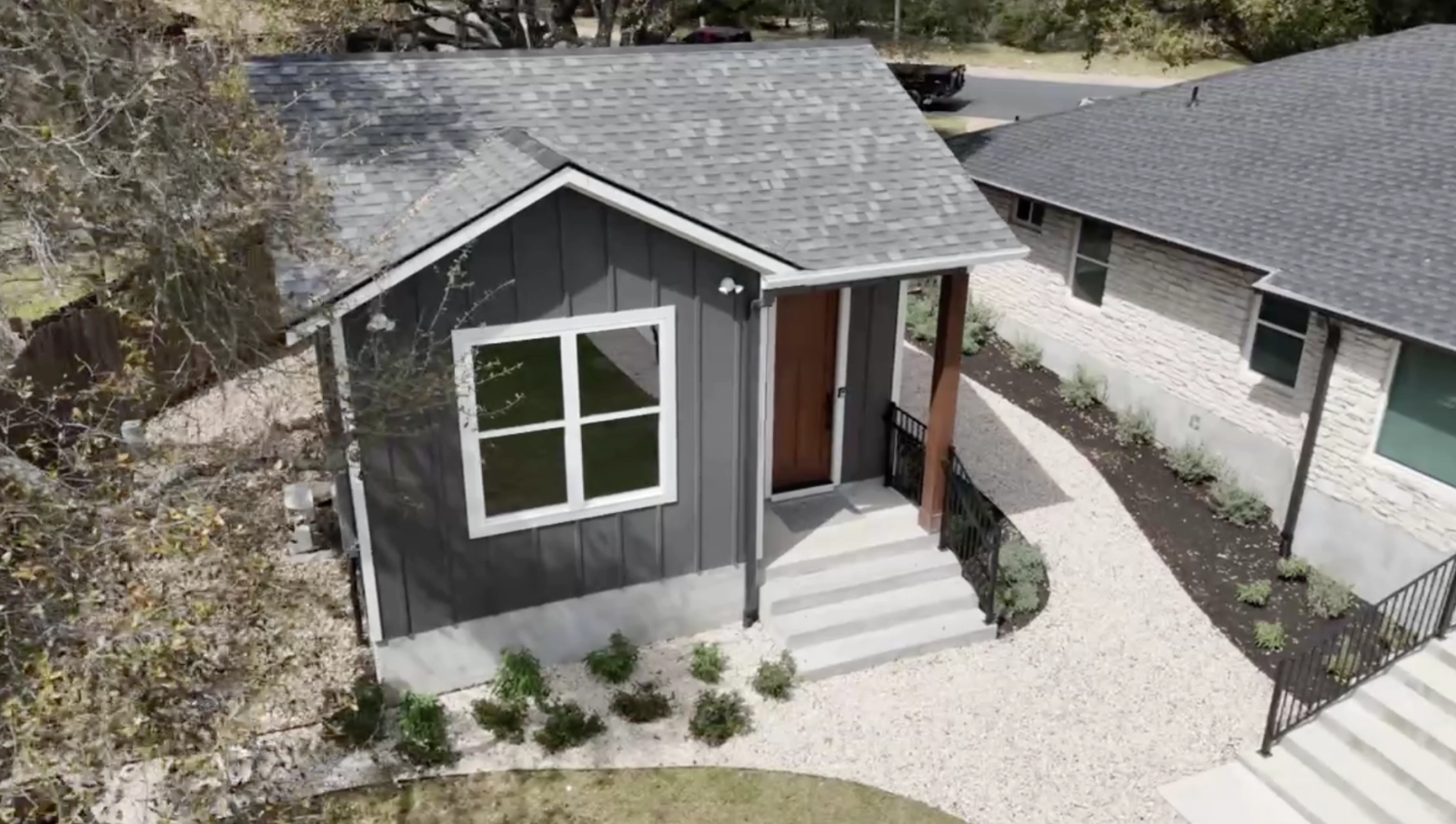
Eight checks can change the rule answer.
A pathway can be available in principle while the intended footprint, unit size, utility plan, or use still does not work on a specific property.
Zoning, overlays, and land status
Confirm base zoning, neighborhood plans, NCCDs, PUDs, overlays, plat status, and any project-specific approvals before using a citywide summary.
Lot area and unit count
The City’s current ADU page uses 5,750 square feet or greater as its minimum lot-area screen for an ADU. HOME Phase 2 covers qualifying lots from 1,800 to less than 5,750 square feet but permits one dwelling, not an extra unit beside another. Verify legal lot status and the existing and proposed unit count.
Size, FAR, and coverage
Austin’s ADU page says size depends on zoning and geographic location. HOME also uses gross floor area, FAR, building coverage, impervious cover, height, and site-specific standards.
Setbacks and separation
Zoning no longer sets a universal minimum distance between covered dwelling units, but property setbacks and technical-code separation still apply. Zero zoning separation is not permission to ignore fire or maintenance access.
Trees, drainage, and flood risk
Protected and heritage trees, critical root zones, grade, runoff, floodplain, and erosion controls can move the footprint or require additional review and design work.
Easements and private restrictions
Recorded utility, drainage, access, or conservation easements can occupy the apparent building area. Deed restrictions and HOA rules are private layers that City zoning does not automatically override.
Access and parking
Austin generally does not require off-street motor-vehicle parking, except applicable accessible-parking or controlling special requirements. Access for occupants, fire, trash, trades, utilities, and staging still affects the plan.
Address, utilities, and permits
Each new dwelling needs a unique address or building number before permit submittal. Water, wastewater, electric, HVAC, meters, capacity, trenching, and trade permits must also fit the site and current provider requirements.
Four rule layers answer different questions.
A zoning “yes” is not a building permit, utility approval, or private-rights opinion. Treating these layers separately makes the remaining risk easier to see.
Land-use and site rules
These determine the residential use, dwelling count, setbacks, floor area, height, building and impervious coverage, and other property standards.
Technical and life-safety codes
Structural, foundation, energy, fire separation, wall openings, electrical, plumbing, mechanical, and other technical requirements govern how the dwelling must be built.
Utility and addressing requirements
Service providers and City departments confirm address, connection, meter, route, capacity, tap, easement, and trade-permit conditions.
Private property restrictions
Deed restrictions, restrictive covenants, and HOA rules can be enforceable between private parties even when a City permit application meets public code.
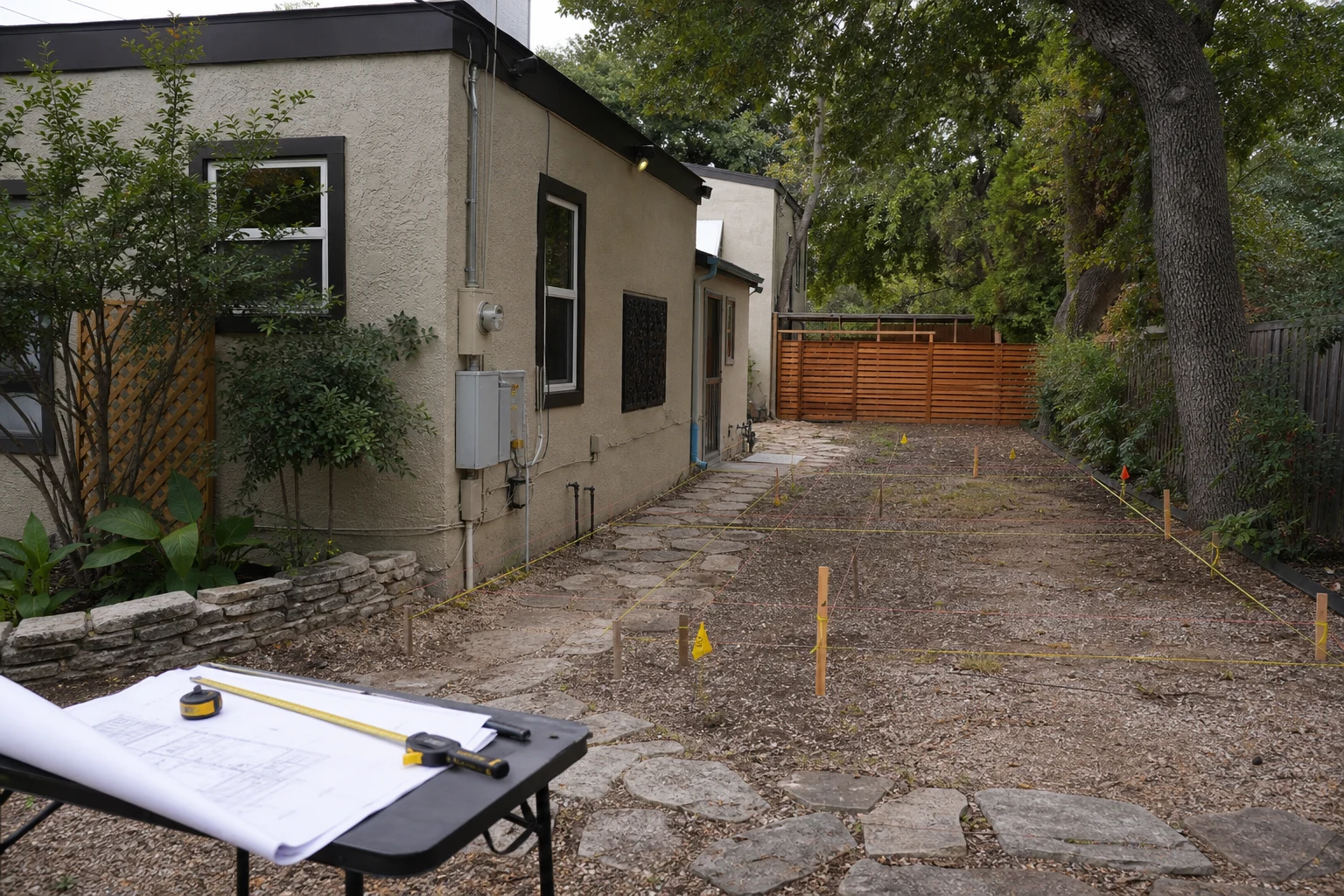
Technical codes and utilities can change the layout after zoning.
Austin Residential Plan Review currently evaluates applicable residential work under the 2024 International Residential Code and locally adopted technical codes. The City also maintains interpretation memos, including 2026 guidance for duplex, two-unit, and three-unit site-development standards.
Fire separation: zoning may no longer require a minimum distance between units, but wall, opening, projection, and fire-resistance requirements still depend on the design and technical code.
New address: request the required address or building number before residential permit submittal so the application and utility planning use consistent identifiers.
Utility scope: determine water, wastewater, electric, HVAC, meter, service-capacity, and trench routes before treating a building estimate as the total project cost.
Permit sequence: resolve existing expired permits, prepare the current application and supporting documents, pay plan-review fees, respond to comments, activate permits, and complete required inspections.
Long-term use and short-term rental rules are not the same.
Designing a legal dwelling does not automatically authorize every rental model. Confirm the intended lease length, current license rules, operator limits, and any private restrictions before using rental income to justify the project.
Short-term rentals require an active operating license.
Austin defines an STR as a residence rented for fewer than 30 consecutive days. City guidance says the use is allowed as an accessory use to residential uses when a valid operating license and current program requirements are satisfied.
- The City’s STR page says licenses became valid for two years under changes effective in October 2025.
- The City’s ADU page says an ADU constructed after October 1, 2015 may not be used as an STR for more than 30 days in a calendar year.
- Operator, spacing, local-contact, advertising, and enforcement requirements can also apply.
Two current City pages give different STR details.
The City’s ADU page says a Certificate of Occupancy must accompany an STR license application. The current STR page says October 2025 changes removed the Certificate of Occupancy and proof-of-insurance requirement for new applications and renewals.
Practical next step: use the current STR application instructions or confirm directly with the STR program before relying on either checklist. Do not design or finance the ADU around short-term-rental use until the property and operator path are confirmed.
Austin ADU rules change log.
This log records the official milestones checked for this page. It does not claim that every code amendment affects every property.
This page was verified against the current City ADU, HOME, Residential Plan Review, Short-Term Rentals, Code Interpretations, Development Policy Corner, trees, deed-restriction, addressing, and parking sources.
The City’s HOME page reports its Phase 1 application-submission data was updated on this date.
Austin Residential Plan Review began updated target review times for listed residential project types, including a 10-business-day target for new construction and additions. Additional review groups or corrections can affect total timing.
The City posted 2026 code interpretations addressing duplex, two-unit, and three-unit site-development standards and parking-structure placement.
City STR program changes took effect, including two-year license terms and removal of the Certificate of Occupancy and proof-of-insurance requirement described on the current STR page.
The City began accepting development applications under Site Plan Lite Phase 2 and Infill Plat changes connected to residential infill review.
The City began accepting HOME Phase 2 applications citywide, including properties in the WUI area or designated by the Uprooted Report.
Austin City Council adopted HOME Phase 2, creating the small-lot single-family residential use.
The City began accepting applications under HOME Phase 1 after Council adoption on December 7, 2023.
Who reviewed this guide and where the rules come from.
The official City and code pages below are the sources to check before you act. Small House Solutions uses them to frame the right property questions; only the responsible authority or qualified professional can issue a formal property, code, utility, title, or permit determination.
- City of Austin: Additional Dwelling Units Definition, minimum screen, addressing, technical separation, STR note, and permit steps · verified July 29, 2026
- City of Austin: HOME Amendments Phase 1 and Phase 2 scope, adoption dates, coverage, separation, small-lot rules, and application transitions · verified July 29, 2026
- City of Austin: Residential Plan Review Current technical-code reference, application sequence, appointments, and review targets · verified July 29, 2026
- City of Austin: Code Interpretation Library Current interpretation index, including 2026 two-unit/three-unit and parking-structure guidance · verified July 29, 2026
- Austin Code § 25-6-471: Off-Street Parking General removal of off-street motor-vehicle parking minimums and accessible-parking provisions · verified July 29, 2026
- City of Austin: Short-Term Rentals Current licensing, 2025 program changes, operator responsibilities, and enforcement · verified July 29, 2026
- City of Austin: Trees on Residential Property Protected and heritage trees, root-zone impacts, surveys, and residential tree review · verified July 29, 2026
- City of Austin: Deed Restrictions and Development Separation between public zoning and privately enforced restrictions · verified July 29, 2026
- City of Austin: Address Management Services Address and building-number request process · verified July 29, 2026
- City of Austin: Development Policy Corner Recent adopted changes, proposed changes, and current policy-monitoring links · verified July 29, 2026
Austin ADU rules FAQ.
Does Austin HOME apply to every residential property?
No. HOME Phase 1 applies to duplex, two-unit residential, and three-unit residential uses in covered SF-1, SF-2, and SF-3 situations; it does not replace the existing rules for single-family residential use. HOME Phase 2 creates a one-dwelling small-lot use for qualifying SF-1, SF-2, and SF-3 lots. Zoning, overlays, lot status, prior approvals, site conditions, and the proposed dwelling count still need to be verified for the address.
How many homes can Austin HOME Phase 1 allow?
The City says HOME Phase 1 can allow up to three housing units, including qualifying tiny homes, on SF-1, SF-2, and SF-3 zoned property when the applicable standards are met. “Up to three” is not a guarantee that every lot can physically, legally, or economically support three units.
What size ADU is allowed in Austin?
There is not one safe citywide size answer. The City’s ADU guidance says required size depends on the zoning district and geographic location. The applicable pathway can also bring floor-area, FAR, building-coverage, impervious-cover, height, setback, tree, drainage, and technical-code limits. Confirm the address and review path before relying on a maximum square-foot figure.
What setbacks apply to an Austin ADU?
Setbacks depend on the property, base zoning, overlays or special districts, the selected land use, and site conditions. Austin no longer has a zoning minimum separation between covered units, but that does not eliminate property setbacks or technical-code separation and fire-resistance requirements.
Is off-street parking required for an Austin ADU?
Austin Code generally does not require off-street motor-vehicle parking, except applicable accessible-parking requirements and controlling special provisions such as certain PUD requirements. If parking is provided, its design and placement still have to comply. Access for residents, emergency response, waste collection, utilities, and construction remains a practical site-plan issue.
Can an Austin ADU be rented?
A legal dwelling may be used for permitted residential occupancy, but lease length and operator model matter. Short-term rentals of fewer than 30 consecutive days require a current Austin operating license and compliance with current STR rules. The City’s ADU page also states that an ADU built after October 1, 2015 may not be used as an STR for more than 30 days in a calendar year. Private deed or HOA restrictions may create separate limits.
Does City approval override an HOA or deed restriction?
Not necessarily. The City explains that zoning laws do not affect the enforceability of deed restrictions and that privately enforced restrictions can remain a civil matter. City staff may have to approve a code-compliant permit even when the proposal conflicts with a private restriction. Review title and association documents separately.
What should I bring to an Austin ADU property check?
Bring the exact address, intended use, desired dwelling count and size, rough budget, timing, survey or plat if available, title or HOA information, photos, known permit history, and any utility records. Missing information should become a documented next check, not an assumption.