
ADU Builder vs General Contractor: Who Should You Trust With Your Home's Next Chapter?
Important: ADU builder vs general contractor is really a trust question: who can protect your home's next chapter through feasibility, design, permitting, trade coordination, inspections, and budget decisions. For most standalone ADU projects, a specialized ADU builder or design-build team is safer; for a broader remodel, a proven general contractor can work if they have recent ADU proof.
An accessory dwelling unit is small in square footage, but it is not small in risk. The wrong hire can miss a setback, underprice utility work, delay permit comments, or treat compact-living design like a normal room addition. The right hire can show you what must be decided before money is committed.
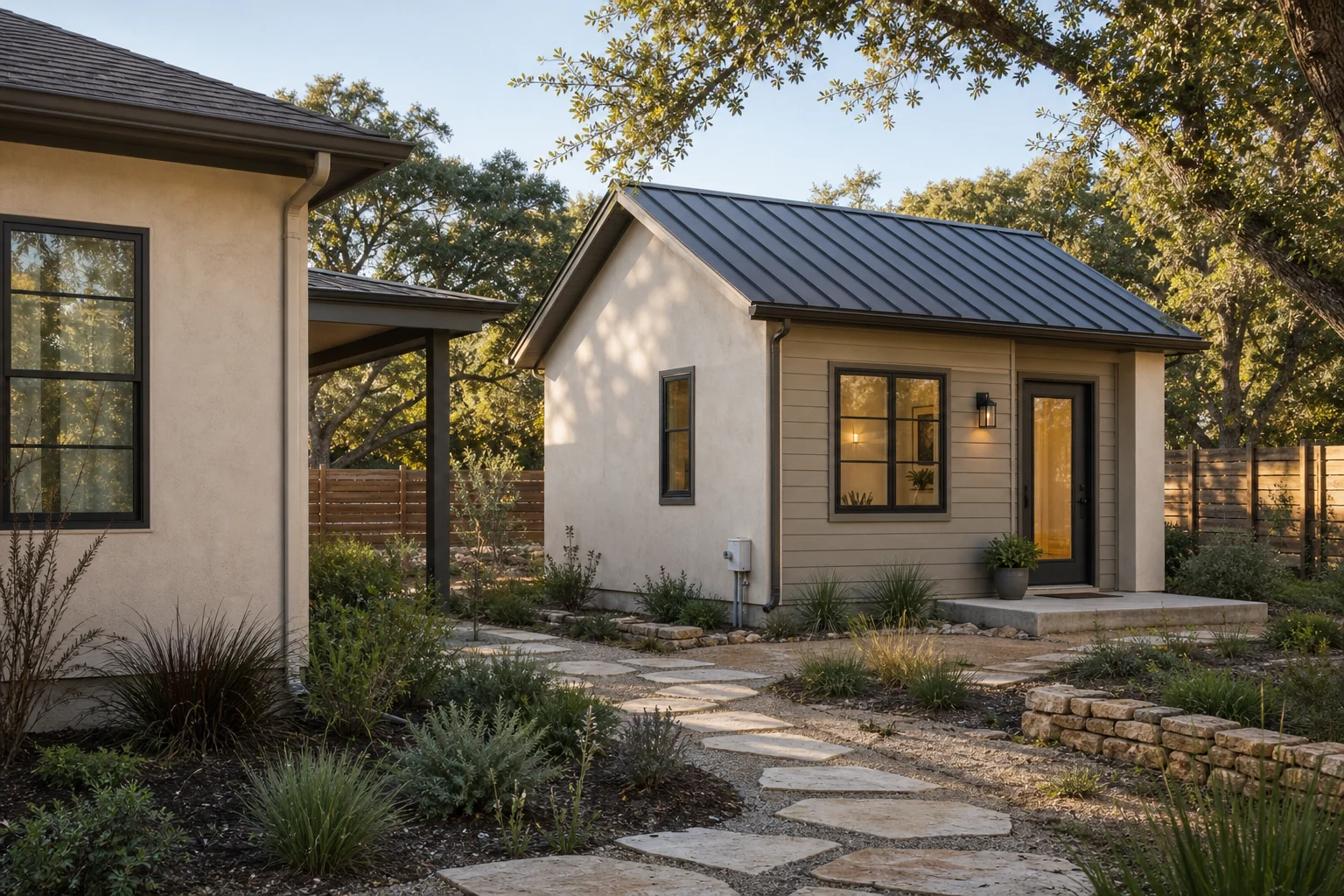
What This Comparison Really Means
An ADU builder is a specialist focused on accessory dwelling units, backyard cottages, garage apartments, detached guest houses, and small-footprint homes. The advantage is continuity: the same team is usually thinking about site feasibility, small-space design, utilities, permit drawings, budget choices, and construction sequence from the beginning.
A general contractor is a construction manager who can coordinate a wide range of residential work. A strong GC can build an ADU, especially when the drawings, engineering, and permit path are already clear. The risk is that some GCs price the visible structure but underweight ADU-specific issues such as separate utilities, fire separation, parking rules, setbacks, address needs, and city review comments.
Which Type of Team Fits Your ADU Project?
The right answer changes with the project. Use these decision cards before you request a price, because the lowest early number is often the least useful number.
ADU Planning Is Where Specialists Earn Trust
A good ADU builder is not just selling a small building. They are testing whether the property can support the plan. That means checking the lot, setbacks, utility path, address needs, tree protection, drainage, emergency access, and the intended use before the drawings become expensive.
This is also where compact design matters. A 500 to 900 square foot ADU has to work harder than a typical addition: storage, daylight, kitchen circulation, mechanical placement, acoustic privacy, washer and dryer location, and outdoor access all affect whether the unit feels useful after move-in.
- Ask an ADU builder: what usually surprises homeowners during feasibility and plan review?
- Ask a general contractor: which ADUs have you personally completed in this city or service area?
- Ask both: what is excluded from your price until the site and permit path are verified?
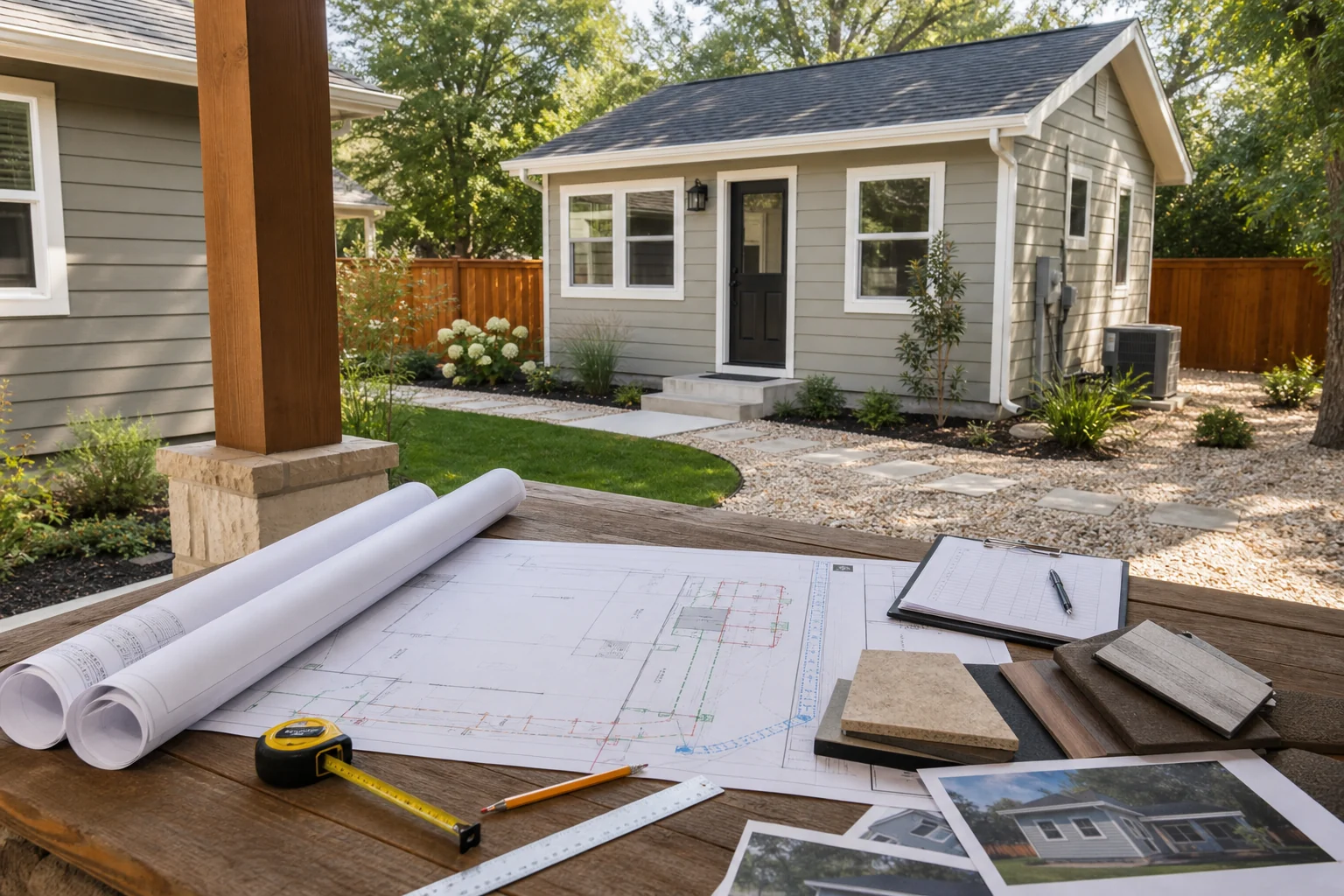
The Trustworthy Hiring Process
Whether you lean toward an ADU builder or a general contractor, the safest process is evidence-based. Trust comes from proof, not a job title.
Confirm the lot, zoning path, setbacks, utilities, trees, drainage, access, and use case before accepting a construction number.
Look for finished ADUs, plan review experience, inspection closeout, and references from projects similar to your property.
Know who creates the plan set, who coordinates engineering, who responds to city comments, and who owns design revisions.
Electrical, plumbing, HVAC, foundation, framing, insulation, and finish trades must be sequenced around a small site and a permit path.
Require written inclusions, exclusions, allowances, site-work assumptions, payment milestones, and change-order rules.
The contractor should explain what must be submitted, what could trigger comments, and when construction can legally begin.
A trustworthy team manages inspections, corrections, trade sign-offs, punch work, and final closeout instead of leaving the homeowner to chase them.
ADU Builder vs General Contractor Decision Map
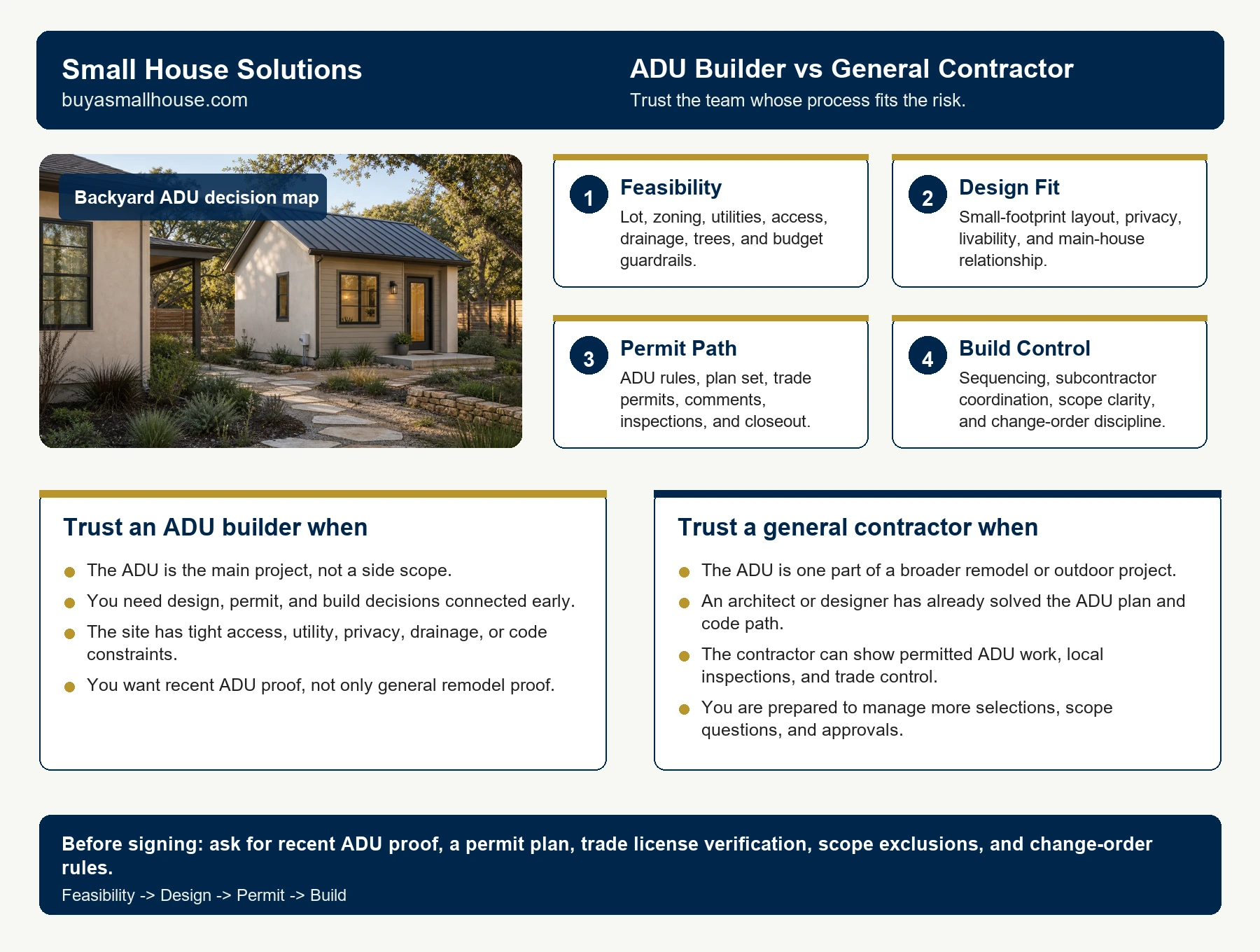
An ADU builder tends to reduce risk when feasibility, design, permitting, and construction are tightly connected. A general contractor can be a good choice when the ADU is part of a larger scope and the ADU plan set is already well defined. Either way, the winning team should be able to explain the risk before they ask you to trust the price.
Cost and Decision Drivers to Compare Early
ADU pricing is shaped by site and scope more than by square footage alone. When you compare an ADU builder and a general contractor, ask both to price the same assumptions.
| Driver | Why it matters | Decision to make early |
|---|---|---|
| Feasibility | A design that ignores setbacks, utility conflicts, tree protection, or drainage can become expensive to redraw. | Pay for enough feasibility work to know whether the plan is real before asking for a final build number. |
| Design responsibility | Some contractors price construction only, while others include design-build coordination and permit drawings. | Clarify who owns plans, engineering, revisions, and city comment responses. |
| Utilities | Water, sewer, electrical, HVAC, gas, trenching, meters, and panel capacity can move the budget quickly. | Ask whether utilities are estimated, verified, excluded, or carried as allowances. |
| Permit risk | Local ADU rules can affect size, location, address, parking, inspections, and review timing. | Require a permit plan and a written assumption list before signing. |
| Trade control | Small sites leave less room for sequencing mistakes, delays, and subcontractor gaps. | Ask who schedules inspections and who manages corrections if a trade fails inspection. |
How Small House Solutions Helps Homeowners Choose With Confidence
Small House Solutions works with homeowners who need more than a generic bid. The goal is to connect the ADU idea to the real property, the local rules, the budget guardrails, and the construction path before the project gets too far ahead of the facts.
FAQ
Is an ADU builder always better than a general contractor?
No. An ADU builder is usually better when the ADU is the core project and feasibility, design, permitting, and construction need to stay connected. A general contractor can be a good fit when the ADU is part of a larger remodel and the contractor has recent permitted ADU experience.
What should I ask before hiring either one?
Ask for recent ADU examples, references, a permit plan, written inclusions and exclusions, utility assumptions, change-order rules, trade coordination details, and who will respond to city review comments.
Can a general contractor build an ADU in Texas?
Yes, a capable general contractor can build an ADU if the design, permits, trade work, inspections, and local rules are handled correctly. The homeowner should verify ADU-specific experience instead of relying on general remodel experience alone.
How do I verify trade credentials?
Ask who will perform electrical, plumbing, HVAC, and other licensed work, then verify applicable credentials with the relevant Texas licensing boards or local authority before work starts.
Why do ADU rules differ by city?
ADUs are regulated through local zoning, building codes, utility rules, deed restrictions, and permitting processes. A project that works in one Texas city may need a different size, location, parking, address, or review path in another city.
Should I choose design-build for an ADU?
Design-build can be helpful when the project needs one team to connect feasibility, small-space design, permit assumptions, budget decisions, and construction details. It is still important to review the scope and contract before signing.
Official Sources and Verification
Rules can change, and city staff may interpret site-specific conditions differently. Use official sources to verify local ADU rules, trade requirements, and permit expectations before you sign a construction agreement.
Make the next chapter of your home easier to trust.
Bring your ADU idea, property questions, and budget concerns to Small House Solutions before you commit to a builder or contractor.