
Village Tiny Homes Austin: Can You Legally Live in a Tiny Home?
Important: if you are searching for village tiny homes austin, the legal answer is not simply yes or no. In Austin, you can live in a tiny home only when the unit, address, zoning path, utilities, permits, inspections, and occupancy proof line up for that specific location.
A tiny home may fit an ADU path, a HOME multiple-unit path, a small-lot path, a permitted community, or another dwelling review path. A tiny-home listing, village name, park model, or pretty cottage photo is not enough proof by itself.
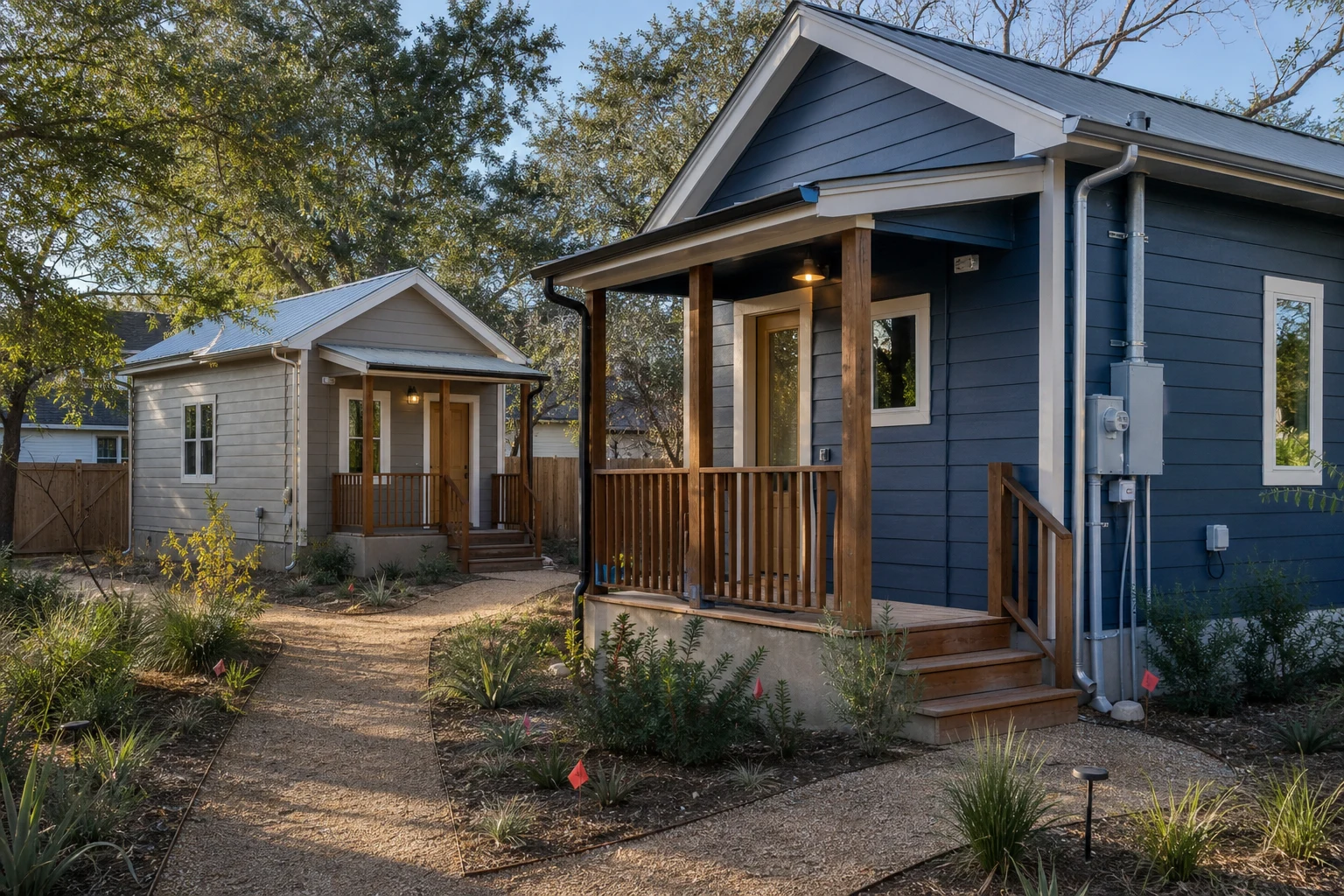
What Counts as Legal Tiny Home Living in Austin?
For Austin planning, the useful question is not only whether the home is small. It is whether the structure is approved as a dwelling unit or legal residential unit in the right place. A permanent tiny home, an ADU, a unit under the Austin HOME amendments, a manufactured or industrialized unit, and a tiny home on wheels can each trigger different review paths.
The City of Austin's ADU guidance says a structure or portion of a structure becomes a dwelling unit when it contains habitable space, a full bathroom, and a sink or dishwasher outside the full bathroom. Once the design crosses that line, the project needs more than a simple shed or accessory-structure assumption.
Why the word village can be misleading
A tiny-home village can mean a marketed community, a dealer display, an RV/park-model setting, a condo-style shared site, a group of ADUs, or a planned multi-unit project. Those labels do not replace zoning, platting, site plan, utility, fire, drainage, and occupancy review.
If a page or listing claims a real Austin tiny-home village, confirm the address, jurisdiction, owner or project representative, approved plans, utility status, and whether it allows long-term residential occupancy.
Six Checks Before You Trust a Village Tiny Homes Austin Result
Use these checks before buying a unit, signing a lot lease, designing a backyard cottage, or relying on a page that claims a real village project.
Jurisdiction
Verify whether the address is in Austin city limits, ETJ, Travis County, another city, or another county review path.
Zoning and lot path
Check SF zoning, HOME eligibility, ADU eligibility, small-lot options, legal lot status, and private restrictions.
Dwelling triggers
Habitable space, bathroom, sink or dishwasher, cooking support, sleeping area, and independent use can trigger dwelling-unit rules.
Foundation or vehicle
Separate permanent dwelling units from tiny homes on wheels, park models, manufactured homes, and industrialized housing.
Utilities and address
Water, wastewater, power, meters, panel capacity, drainage, address, inspections, and CO need a clear path.
Proof before claiming
If a page claims a real project or community, confirm location proof, approvals, photos, owner permission, and current status before relying on the claim.
How to Compare ADU, HOME, Small-Lot, and Village Paths
The cleanest tiny-home path is usually the one that starts with the address. In Austin, the HOME amendments can open options for multiple housing units, including tiny homes, on certain SF-zoned properties when the project matches the standards. ADU rules may also apply when the tiny home is a separate dwelling unit on the same property as a single-family home.
A tiny-home community or village path is a different question. Shared infrastructure, drives, drainage, fire access, water, wastewater, unit addressing, private maintenance, and occupancy rules can turn the project into a broader site-development and proof problem.
Before you choose plans or pricing, decide whether the goal is an owner-occupied backyard unit, a long-term rental, a family cottage, a small-lot home, a community lot, or a non-dwelling accessory structure.
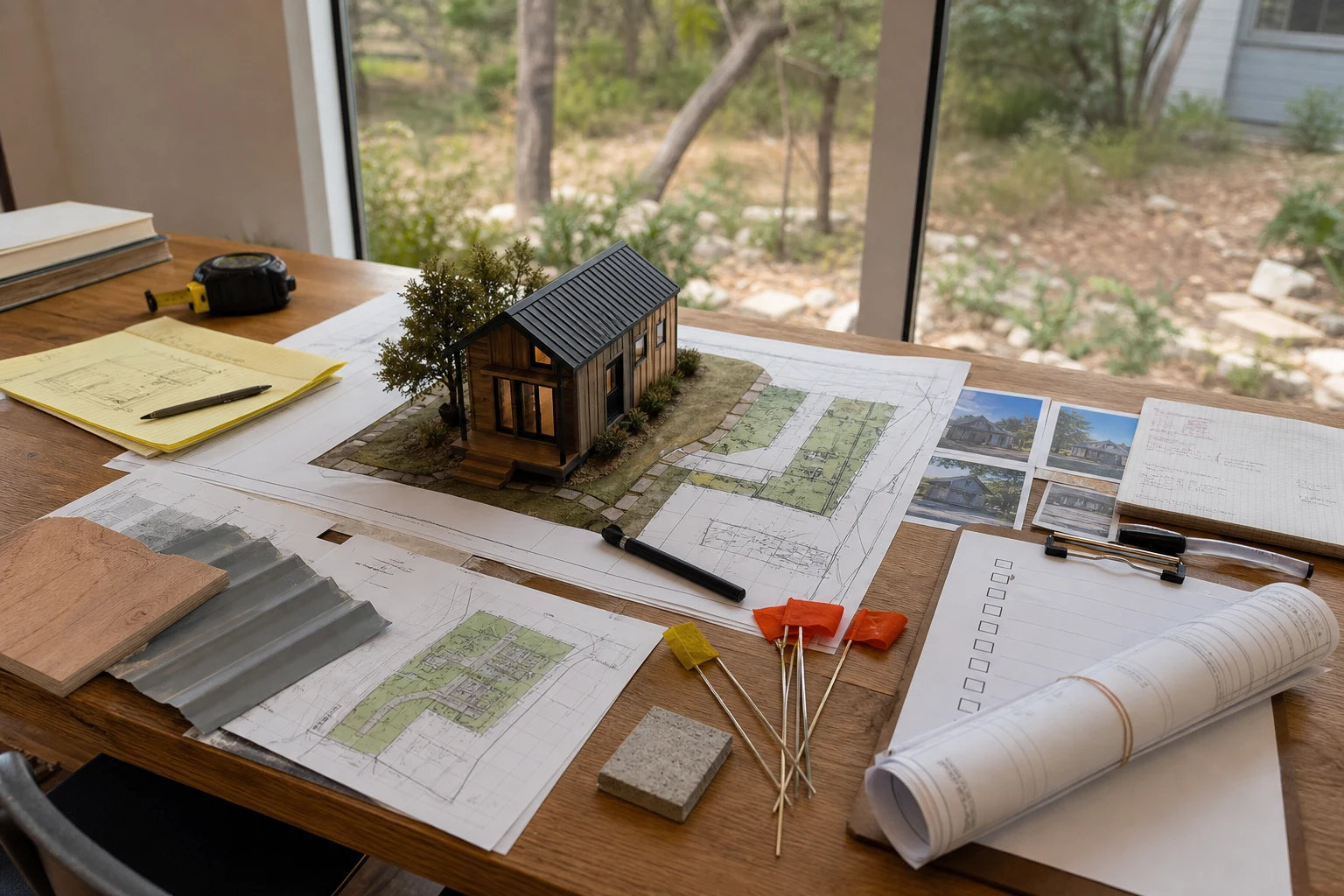
The Safer Tiny Home Legal-Path Process
Verify the address
Confirm city, county, ETJ, floodplain, utilities, zoning, lot status, and private restrictions.
Name the unit type
Separate ADU, HOME unit, small-lot home, industrialized housing, manufactured home, RV, and park model paths.
Check dwelling elements
Identify habitable space, bathroom, sink, cooking support, sleeping area, address, and utility scope.
Review site limits
Study access, drainage, trees, impervious cover, setbacks, fire separation, and construction staging.
Map utilities
Confirm water, wastewater or septic, power, HVAC, gas, metering, and panel capacity.
Prepare submittal
Create the site plan, construction drawings, energy/code notes, utility plan, and required documents.
Build to approval
Follow approved plans, inspections, changes, documentation, and closeout requirements.
Confirm occupancy
Do not move in or market occupancy until the legal use and final approval are documented.
Austin Tiny Home Decision Map
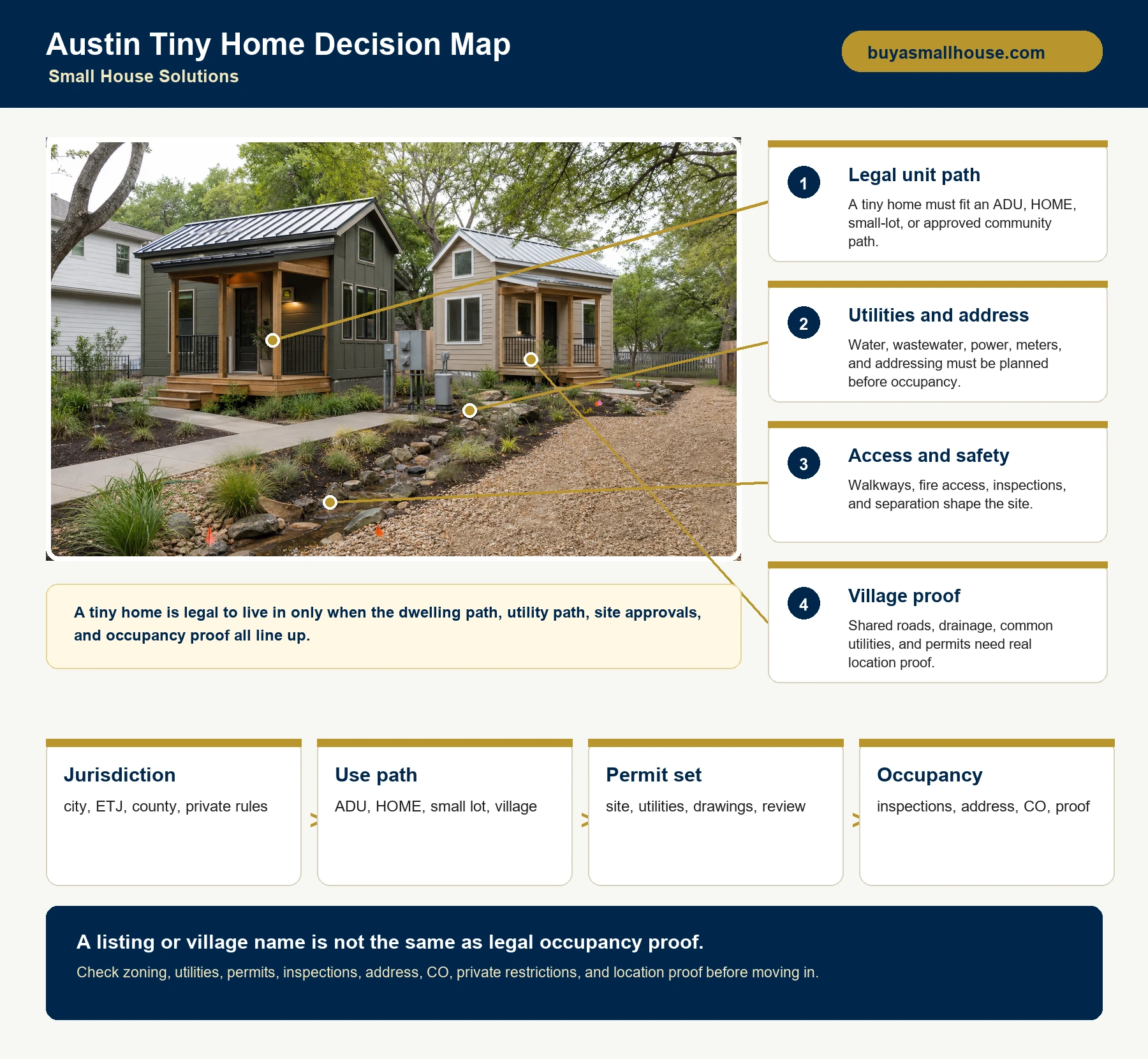
Decision Drivers That Change the Answer
| Driver | Why it matters | Decision to make early |
|---|---|---|
| Jurisdiction | Austin city limits, ETJ, Travis County, and nearby cities can route tiny homes differently. | Verify the exact address before applying any rule. |
| Unit type | ADU, HOME unit, small-lot home, manufactured home, industrialized home, RV, and park model are not the same. | Name the legal object before buying or designing. |
| Zoning and lot status | The site must support the use, unit count, lot area, access, and development standards. | Check zoning, lot status, private restrictions, and HOME/ADU eligibility. |
| Utilities | Long-term occupancy needs water, wastewater, electrical capacity, HVAC strategy, and safe connections. | Map systems before assuming a tiny home can be occupied. |
| Site infrastructure | Village-style projects may involve shared drives, drainage, fire access, addressing, and common utility systems. | Confirm infrastructure and maintenance responsibilities. |
| Permit closeout | A nice-looking unit can still lack final approval for residential occupancy. | Ask what inspections and CO or closeout documents prove occupancy. |
| Rental or STR use | Living in the unit and renting it short-term are different legal questions. | Separate owner/family use, long-term rental, and short-term rental assumptions. |
| Business proof | Named-village proof matters before relying on a real project or location claim. | Confirm the project, address, approvals, and owner permission before claiming a specific village. |
How Small House Solutions Helps
Small House Solutions helps homeowners turn tiny-home questions into a real property plan. The goal is to avoid buying a unit, choosing a village concept, or pricing a backyard cottage before the legal path is known.
Feasibility first
Review the address, jurisdiction, zoning, lot path, private restrictions, utilities, and dwelling-unit triggers.
Path comparison
Compare ADU, HOME, small-lot, backyard cottage, village/community, and non-dwelling options before plans.
Permit-ready next step
Move from an idea to site plan, design scope, utility review, submittal documents, inspections, and closeout.
FAQ
Can you legally live in a tiny home in Austin?
Yes, but only when the tiny home is approved as a dwelling through the right path. In Austin that usually means a code-compliant unit on a legal lot or approved project path, with utilities, permits, inspections, address or unit identification, and occupancy approval.
Does a tiny home village in Austin make the home automatically legal?
No. A village, community, listing, or dealer name is not legal occupancy proof by itself. The location, zoning, infrastructure, utility approvals, fire access, permits, inspections, and final occupancy path still have to be verified.
Are Austin tiny homes treated as ADUs?
Sometimes. A tiny home can function as an ADU or as one unit in a HOME multiple-unit path if the property, zoning, lot, size, utilities, and dwelling-unit requirements fit. It is not automatically an ADU just because it is small.
Can a tiny home on wheels be a full-time home in Austin?
A tiny home on wheels raises a different review question than a permanent dwelling. It may be treated more like an RV or vehicle-based unit, so placement, utility hookup, occupancy, park rules, and zoning must be checked before relying on it for full-time housing.
What makes a tiny home a dwelling unit in Austin?
Austin's ADU guidance says a structure or portion of a structure is a dwelling unit when it contains habitable space, a full bathroom, and a sink or dishwasher outside the full bathroom. Once those elements are present, dwelling-unit rules and approvals matter.
Can Austin HOME rules allow tiny homes?
Austin's HOME Phase 1 guidance says up to three housing units, including tiny homes, may be allowed on SF-1, SF-2, and SF-3 properties when the project fits the applicable standards. The address still has to be checked.
What should I verify before buying or moving into a tiny home?
Verify jurisdiction, zoning, legal lot status, HOME or ADU eligibility, foundation or vehicle status, utility connections, drainage, fire access, address, deed restrictions, HOA limits, permits, inspections, and final occupancy documentation.
Can Small House Solutions help compare the legal paths?
Yes. Small House Solutions can help compare an ADU, HOME multiple-unit plan, small-lot path, backyard cottage, tiny-home village concept, or non-dwelling structure before you commit to plans, purchase, or construction pricing.
Official Sources and Verification
Tiny-home rules can change and are property-specific. Use official sources first, then confirm the actual address, private restrictions, unit type, permit path, and current staff interpretation before committing money.
City of Austin HOME Amendments
Austin states that HOME Phase 1 allows up to three housing units, including tiny homes, on SF-1, SF-2, and SF-3 zoned properties when the project fits the applicable residential use path.
City of Austin Additional Dwelling Units
Austin defines a dwelling unit by habitable space, a full bathroom, and a sink or dishwasher outside the full bathroom, and connects ADU projects to address, permit, inspection, and Certificate of Occupancy steps.
City of Austin Residential Plan Review
Austin routes new construction, additions, additional dwelling units, interior remodels, and certain conversions through residential plan review and technical-code review.
City of Austin Work Exempt from Building Permits
Austin lists narrow work exemptions and warns that exempt work must still comply with code; dwelling use, utilities, and occupancy should be verified before relying on an exemption.
Texas Department of Licensing and Regulation Industrialized Housing and Buildings
TDLR regulates industrialized housing and buildings that are constructed in modules and installed on permanent foundations, which matters when a factory-built tiny home is part of the plan.
Check the legal path before you buy or move in.
Send the address, intended use, unit type, and any listing or village proof you have. Small House Solutions can help separate inspiration from an approvable tiny-home plan.